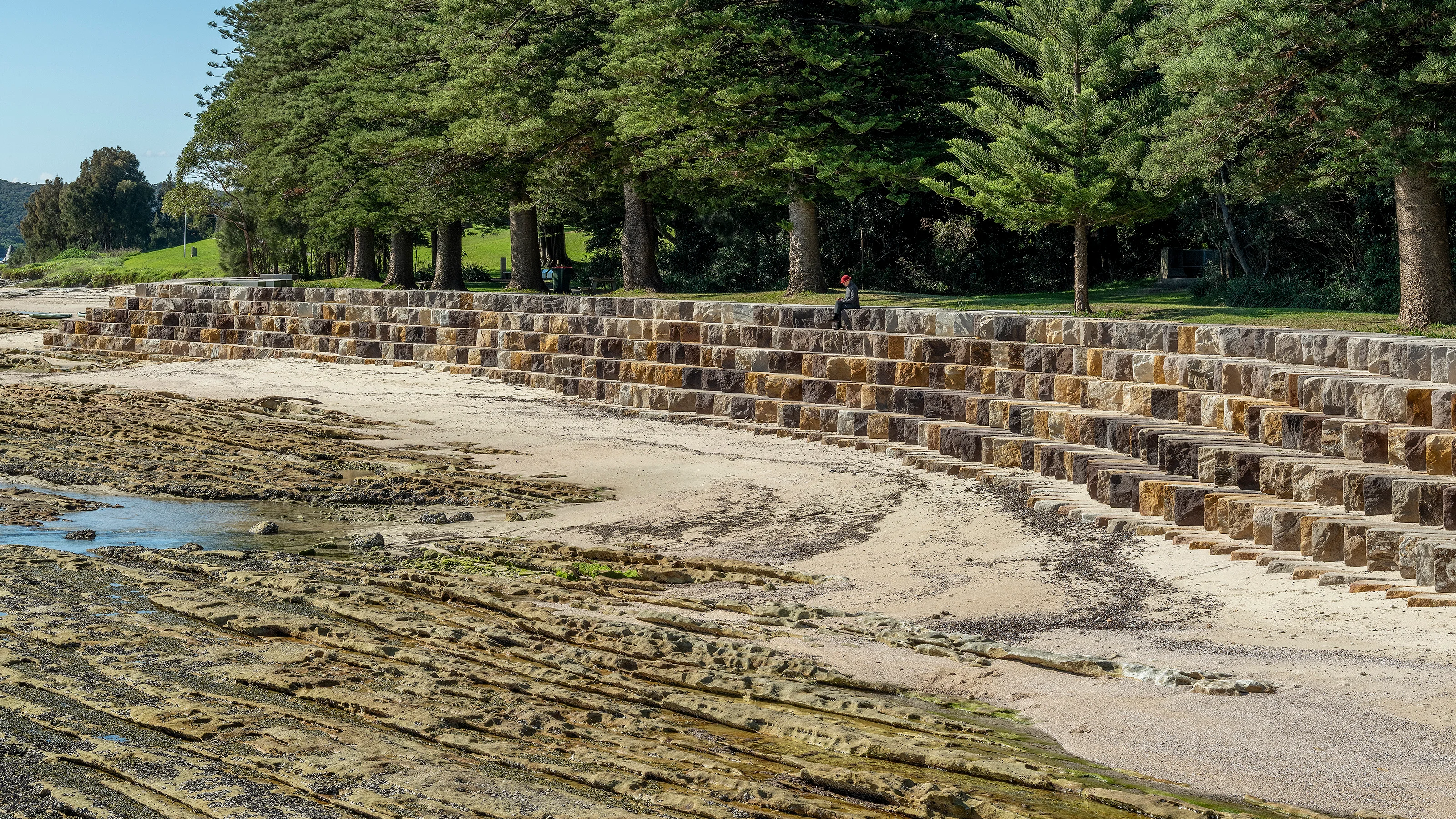
Kamay Foreshore Revetment Wall
Fortifying against erosion, the revetment design creates a new relationship between people and site.
OCULUS designed a sandstone revetment for Kamay Botany Bay National Park that protects the foreshore from coastal erosion while strengthening visitors’ connection to place. The site is a significant place for both Indigenous and non-Indigenous cultures, being the location of Captain Cook’s landing in 1770.

The revetment features a tiered configuration of massive sandstone blocks. (Image: Simon Wood Photography)
The design uses sandstone blocks to reflect the site’s geology and material character, integrating seating, native planting and carefully detailed edges to create places for pause, movement and engagement with the bay. The use of sandstone blocks as a substrate creates a visual language that honours the materiality and natural geology of the site.
The design prioritises protection of the foreshore from coastal erosion while also communicating the natural history of the site through its native planting palette and intrinsic materiality.

Relief-carved artworks by Aboriginal artist Shane Youngberry have been cut directly into the sandstone. (Image: Simon Wood Photography)
The revetment enables a renewed relationship between people and landscape, revealing the natural history and coastal qualities of this significant national park setting. It also delivers long-term environmental and social sustainability, creating a durable asset that balances coastal resilience with public amenity.

(Image: Simon Wood Photography)

The design team prioritised a non-invasive, layered landscape infrastructure model. (Image: Simon Wood Photography)

(Image: Simon Wood Photography)
Project Details
Year
2021–2025
Location
Kamay Botany Bay National Park, Kurnell, NSW
Indigenous Country
Goorawal/Gweagal Country
Team
- Aidan Smith
- Morgan Watt
- Roger Jasprizza
- Simon Trick
- Will Whitfeld
Collaborators
- Consult Marine
- La Perouse Local Aboriginal Land Council (LPLALC)
- Shane Youngberry